
Applying analytical and deep learning techniques to realize microscopic birefringence imaging in 3D.
|
from the Laboratory of Rudolf Oldenbourg at |
|

Polarized Light Field Microscopy
Light field microscopy was first introduced in 2006 by Marc Levoy and colleagues at Stanford University. For an introduction, see Stanford Light Field Microscope Project. For more publications, see PLFM Bibliography. The Oldenbourg Lab is well known for developing and applying new polarized light analysis techniques and their incorporation into traditional light microscopes, such as the LC-PolScope and the OpenPolScope system. By harnessing instantaneous volumetric imaging using light field microscopy, including the creation of multiple perspectives based on a single snapshot of the object under observation, the lab extends traditional polarized light microscopy from mapping 2D to 3D spatial and orientational parameters of molecular species in living cells and tissues. For first publications, see PLFM Bibliography.
|
|
|
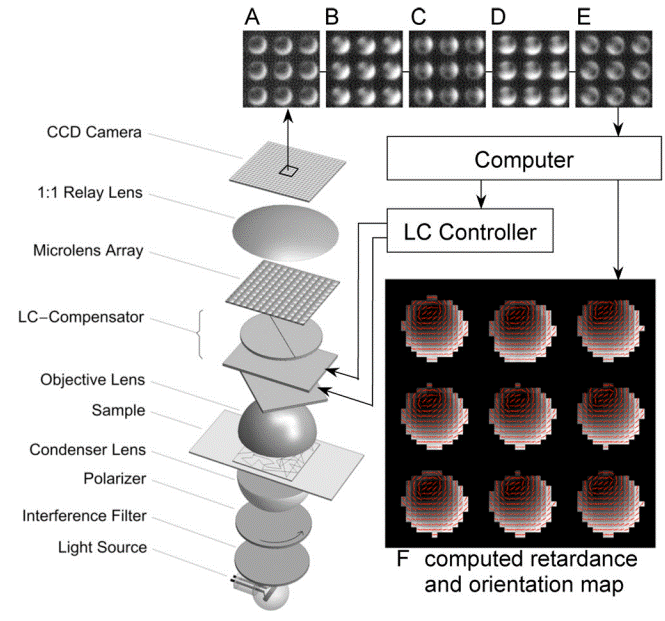
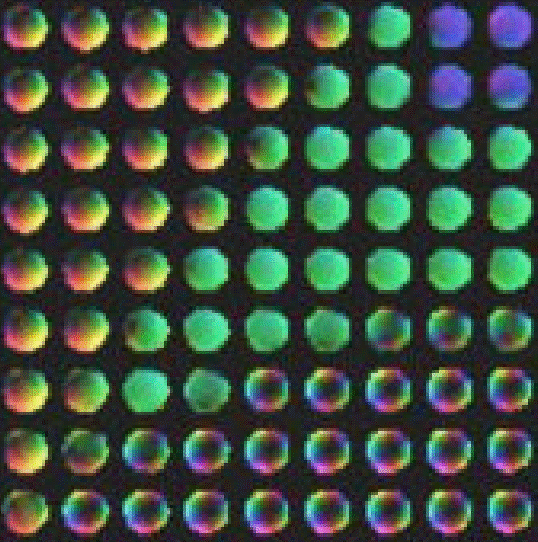
For creating 3-dimensional maps of local object parameters, such as the refractive index or fluorescence density and their anisotropies, we are starting to enlist computational neural networks and deep learning approaches to establish the connection between 3D objects and their light field images. For first publications from other labs in this new area of research, see PLFM Bibliography.
Finally, we have started to employ computational modeling to generate light field images of objects whose parameters are defined on a 3- dimensional grid of volume elements or voxels. We use ray tracing and wave optics simulations to find the so-called forward solution in imaging, i.e. what is the predicted (light field) image of a known object. The data pairs of simulated objects and their light field images are being used to train a computational neural network that will ultimately be capable of estimating an object based on its known light field image. The generation of data pairs of simulated objects and their light field images, and their use in training computational neural networks for solving the inverse problem, i.e. estimating an object from its light field image, is an active research subject in the Oldenbourg Lab. Also, see Polarized Light Field Microscopy at OpenPolScope.org.
Project Collaborators
· Dr. Rudolf Oldenbourg, MBL
· Dr. Patrick La Riviere, University of Chicago
· Geneva Schlafly, PhD candidate, University of Chicago
· Josué Page Vizcaíno, PhD candidate, Technical University of Munich
· Amitabh Verma, Scientific Informatics Analyst, MBL
· Grant Harris, Research Engineer, Explorative.Engineering
The Laboratory has a long tradition of instrument development for live-cell imaging using polarized light microscopy techniques including birefringence, diattenuation and polarized fluoresence imaging. Our open source technology is available at:
|
|
OpenPolScope is an open implementation of birefringence imaging system which can be added to most optical microscopes created and is maintained by the Oldenbourg Lab. |

Light Field Microscopy plug-in for napari
[]
We utilize and contribute to the Python and Java open-source bioimage informatics ecosytems, including:

